About Search Page Optimizer (SPO)
About Search Page Optimizer (SPO)

This is for:
System Administrator

|
The Search Page Optimizer (SPO) feature is in early access. Contact your Coveo representative to have it enabled for your Coveo organization. |
Coveo Machine Learning Search Page Optimizer (SPO) models rerank products on commerce search result pages to optimize product ordering toward business outcomes such as engagement and conversion.
SPO models learn from the behavioral signals visitors generate as they interact with your search results, such as clicks, add-to-cart actions, and purchases. Using these signals, SPO refines the ranking produced by the Coveo index so that the products most likely to drive conversions appear higher on the search result page.
SPO doesn’t replace your other ranking mechanisms. Instead, it learns the optimal balance between all the signals that contribute to your ranking, including text relevance factors, Coveo Machine Learning (Coveo ML) model outputs, and product popularity, removing the need to tune ranking weights manually.

|
Notes
|
How SPO differs from Listing Page Optimizer
SPO optimizes search result pages, where visitors express explicit intent through a query. Its counterpart, Listing Page Optimizer (LPO), optimizes product listing pages (PLPs), such as category and browse pages, where there’s no query. Together, they cover the two main product discovery surfaces of a commerce storefront.
How SPO works
When a visitor performs a query, the Coveo index retrieves and ranks products using its standard ranking process. The SPO model then reranks the top results before the search result page is returned to the visitor. This happens within the normal query flow and adds no perceptible delay. If the model is unavailable for any reason, results fall back transparently to the standard index ranking.
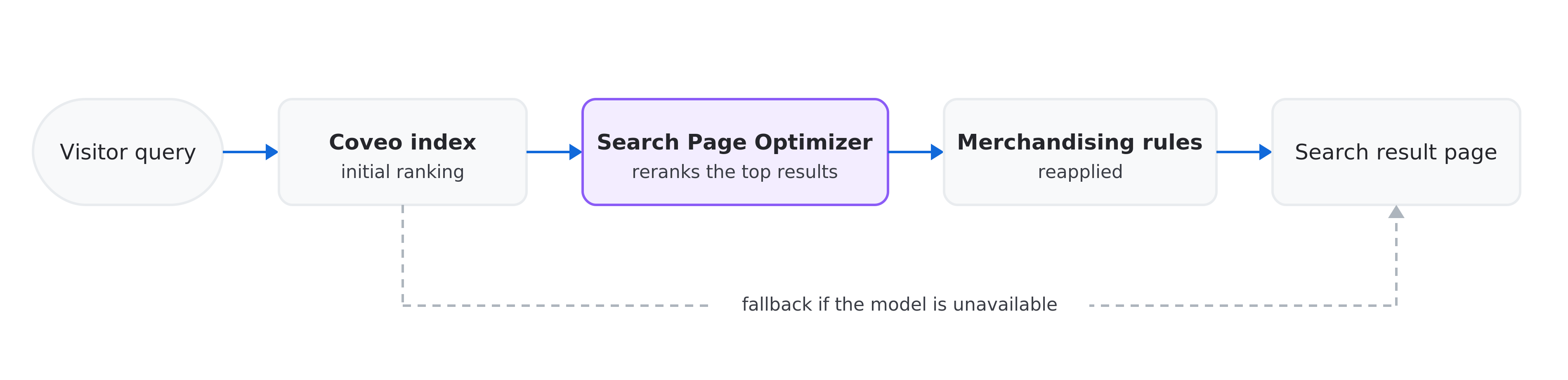
The model improves continuously through the following cycle:
-
Visitors interact with search results. Clicks, add-to-cart actions, and purchases are captured as behavioral signals through commerce event tracking.
-
The model retrains daily. SPO trains on a rolling window of recent behavioral data, learning which products visitors preferred in the context of their queries. Daily retraining lets the model adapt as catalogs, seasons, and shopper preferences change.
-
Search results are reranked at query time. For each query, the model rescores the top results and reorders them so that the products most likely to convert rank higher.
Because training is grounded in conversion signals rather than clicks alone, the model learns which products visitors buy, not only which ones they look at.
|
|
Note
A model can take anywhere from several minutes to several hours to build, depending on the size of the model dataset and the number of model build requests in the queue (system load). |
For a closer look at how the model learns, see Search Page Optimizer methodology.
How SPO interacts with other ranking mechanisms
SPO works with the other mechanisms that shape your product ranking, rather than replacing them:
-
Coveo Machine Learning models: SPO works alongside models such as Automatic Relevance Tuning (ART) and Intent-Aware Product Ranking (IAPR). These models produce ranking signals, and SPO learns how to weigh their outputs together with text relevance and popularity signals to produce the final ordering. SPO doesn’t replace these models.
-
Merchandising rules: Explicit merchandising rules, such as pin rules and ranking expressions, are excluded from the SPO reranking scope and are reapplied after reranking. Your manual interventions always take precedence, so merchandisers retain full control over their strategic decisions while SPO automates the tactical balancing of ranking signals.
-
Personalization: SPO optimizes ranking based on aggregate visitor behavior. It doesn’t personalize results for individual visitors; that’s the role of models such as IAPR.
Visitors on your Coveo-powered commerce site frequently search for drill.
The index ranks results using text relevance, so products with "drill" prominently in their title and description rank highest, including drill accessories and replacement parts.
Over time, behavioral data shows that visitors searching for drill overwhelmingly add cordless power drills to their cart, while accessory clicks rarely lead to a purchase.
The SPO model learns this pattern and reranks the results so that the drills visitors actually buy appear at the top of the page, while accessories rank lower.
As purchasing behavior shifts, for example toward a newly released model, the daily retraining cycle adjusts the ranking accordingly.
Prerequisites
To be able to use an SPO model, make sure that you:
-
Have product data indexed in a Catalog source, with the standard commerce fields mapped.
-
Have a search implementation with meaningful search traffic. The model trains on behavioral data, so it needs a substantial history of search events with visitor interactions before rankings stabilize.
-
Ensure that your search interface logs commerce events, minimally search, click, cart, and purchase events.
SPO models are based on Coveo Analytics data. For new implementations, ranking quality improves as more behavioral data becomes available with each retraining. Implementations typically begin with other Coveo Machine Learning models and add SPO once sufficient interaction history has accumulated.
What’s next
To understand how SPO learns from visitor behavior and applies what it learned at query time, see Search Page Optimizer methodology.