Search Page Optimizer methodology
Search Page Optimizer methodology

This is for:
System AdministratorSearch Page Optimizer (SPO) models use an approach known as learning to rank. This article explains the methodology at a high level: how the model learns from visitor behavior, what information it considers, and how it applies what it has learned at query time.
For an overview of the feature, see About Search Page Optimizer (SPO).
What is learning to rank?
Coveo traditional search ranking assigns each product a score by combining many relevance factors, such as keyword matches, popularity, and Coveo Machine Learning (Coveo ML) outputs, using a set of weights. Choosing those weights is difficult: they interact with each other, they differ from one catalog to another, and the best combination changes over time.
Learning to rank takes a different approach. Rather than relying on manually chosen weights, the model learns the best way to combine ranking signals directly from examples of what visitors preferred. For each search query, past visitor behavior indicates which products should have ranked higher. The model studies many of these examples and learns how to order results so that the products visitors actually want appear first.
How SPO learns from visitor signals
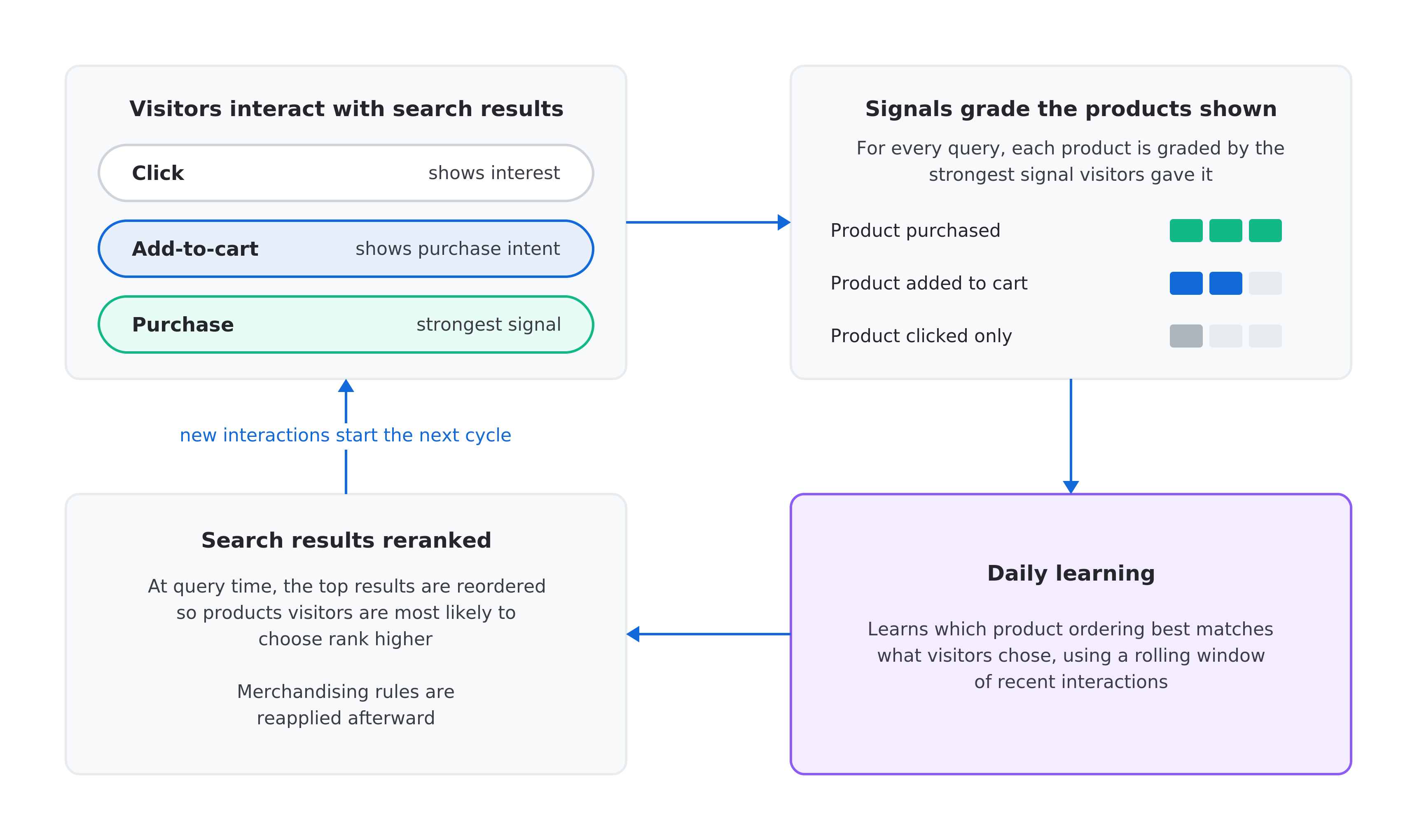
Not all interactions carry the same meaning. A click shows interest, an add-to-cart shows purchase intent, and a purchase confirms value. The model treats these signals accordingly: for each query, every product shown is graded by the strongest interaction visitors gave it, and stronger signals weigh more heavily in what the model learns.

What the model considers
When learning how to order results, the model considers the signals that already contribute to your ranking:
-
Relevance signals from the Coveo index, such as keyword matches and text relevance factors.
-
Outputs from other Coveo Machine Learning models, such as Automatic Relevance Tuning (ART) and Intent-Aware Product Ranking (IAPR).
-
Product popularity, computed from aggregate visitor behavior, such as how often a product is clicked, added to cart, or purchased.
Explicit merchandising rules, such as pin rules and ranking expressions, are deliberately excluded. The model never learns to override them; they’re reapplied after reranking and always take precedence.
How daily learning works
The model retrains every day on a rolling window of recent behavioral data. This keeps the ranking aligned with current visitor behavior as catalogs, seasons, and preferences change. The model compares the ranking shown with the products visitors chose and learns which product ordering better matches observed behavior. Each reranked result page generates new interactions, which feed the next learning cycle.
How SPO applies what it learned at query time
-
A visitor submits a query.
-
The Coveo index retrieves and initially ranks candidate products.
-
The model rescores the top results and reorders them based on what it learned. Results beyond the top set keep their original order.
-
Merchandising rules are reapplied.
-
The final search result page is returned to the visitor.
How to interpret SPO behavior
Keep the following in mind when interpreting SPO behavior:
-
SPO optimizes relative ordering. It determines the order of the top results of each result set; it doesn’t determine whether a product is indexed, and it doesn’t expand or replace the candidate result set.
-
SPO learns from aggregate behavior over time. A single interaction doesn’t necessarily cause an immediate ranking change. The model learns from many observations across visitors.
-
Learning quality depends on your signals. The model learns effectively only when it has sufficient, correctly tracked behavioral signals. Evaluate SPO using appropriate search engagement and business metrics.
What’s next
-
For the feature overview, prerequisites, and how SPO fits with your other ranking mechanisms, see About Search Page Optimizer (SPO).
-
To explore the other Coveo Machine Learning models available for commerce, see Commerce models.