Facet manager
Facet manager

This is for:
MerchandiserThe Facet manager is part of the Coveo Merchandising Hub (CMH) and allows merchandisers to manage all the facet fields and facet collections for their Coveo-powered storefronts from one convenient location. With this tool, merchandisers can manage how facets are displayed to visitors on product listing and search results pages.
All changes made in the Facet manager are instantly reflected in the Facet tabs of the Search manager and the Product listing manager. The changes are also automatically applied to storefronts without requiring any additional steps.

|
Note
For general information on facets, consult the section The more you know: All about facets. |
Prerequisites
To successfully use this feature, your Coveo organization must:
-
Have the Facet or Multi-value facet option enabled on the Fields (platform-ca | platform-eu | platform-au) page for every field intended to be used as a facet. For a facet to be used as a relevance-based facet, the following options must also be selected:
-
The Facet Generator option.
-
The Search operator option. Activating this option requires that the source be rebuilt in order for the changes to take effect.
-
-
Have a compatible version of Headless. We recommend version 3.24.1 or later.
Facet manager main page
The Facet manager main page is accessed through the CMH interface and provides merchandisers with an overview of all configured facet collections and facet fields for a specific property.
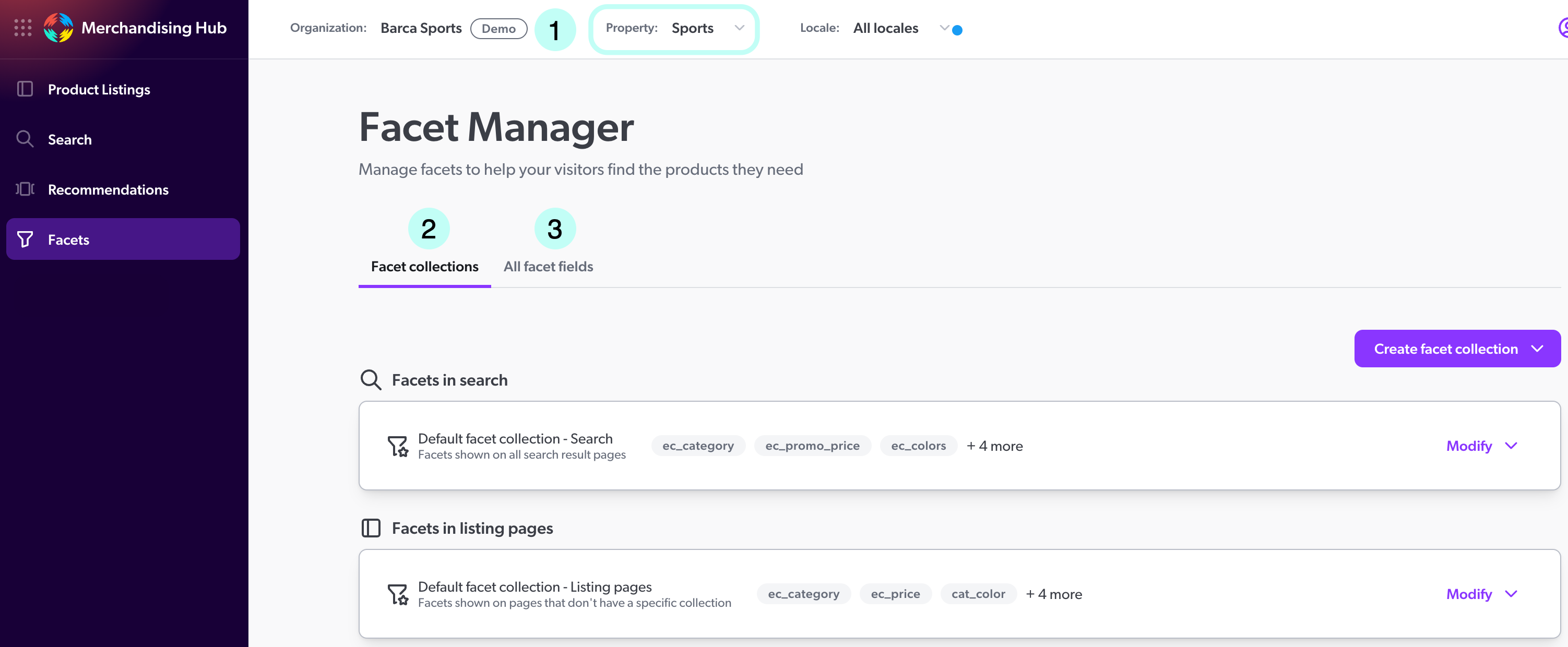
1 |
The Property selector lets merchandisers select the property used to scope the facet collections and fields displayed in the Facet manager. See Property and locale selectors for more information about properties. |
2 |
The search bar lets merchandisers search for existing facets using their facet field name. |
3 |
The Facet collections tab lets merchandisers access all the configured facet collections for the selected property. |
4 |
The All facet fields tab lets merchandisers view a list of all the facet fields available for the selected property. |
5 |
The Performance tab lets merchandisers view facet engagement for the selected property. |
Facet collections tab
The facet collections tab provides merchandisers with a list of all the facet collections for both the search result pages and product listing pages. From this tab, merchandisers can:
-
Create new facet collections.
-
Edit existing facet collections.
-
Delete facet collections.

|
It’s important that all languages within a facet field are assigned a display name, especially when using relevance-based facets. Example: The facet field |
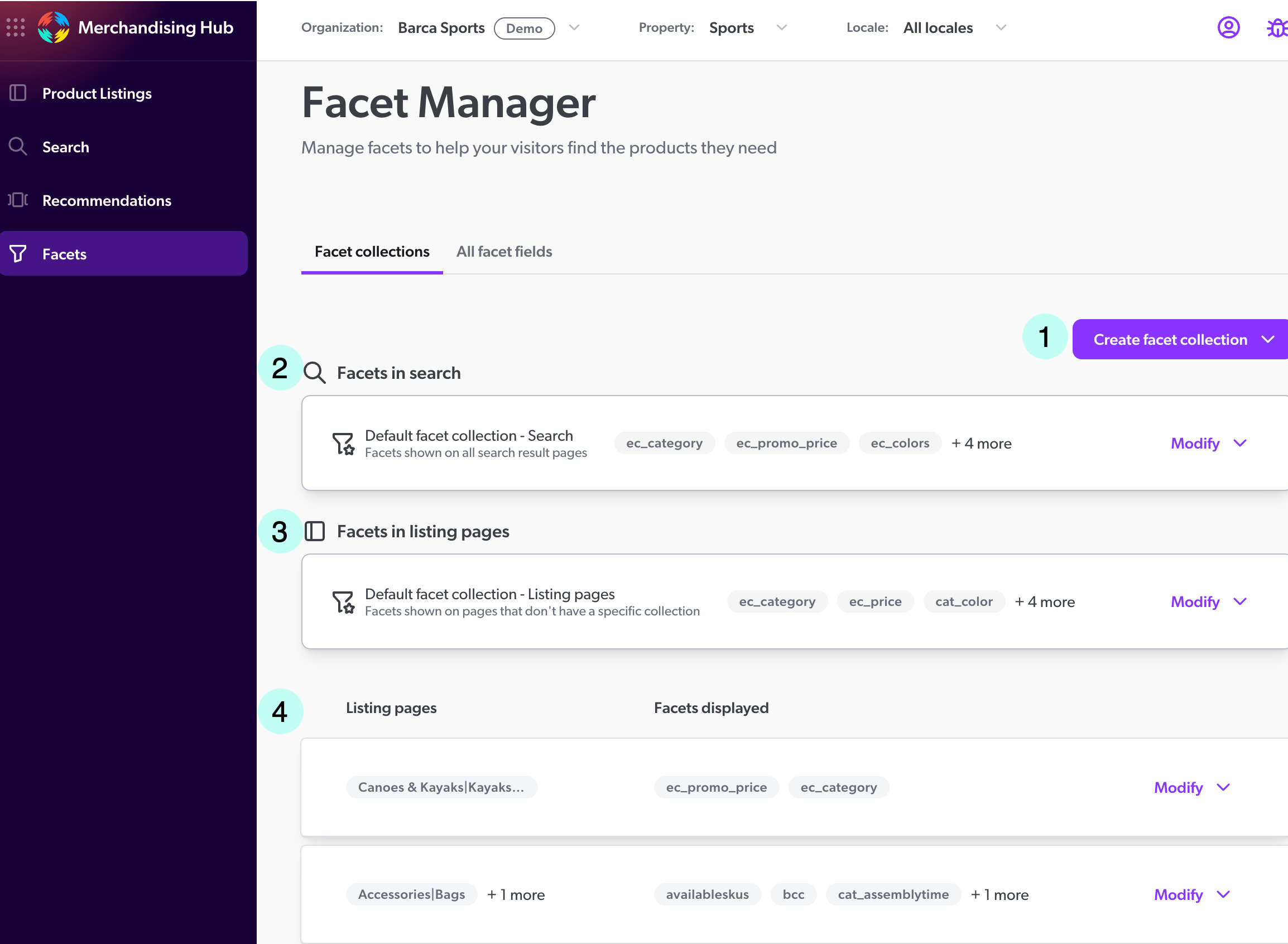
1 |
The Create facet collection button lets merchandisers create new facet collections. They can create a default facet collection for Search or for Listing pages if none exist, or can create customized collections for specific listing pages. |
2 |
The Facets in search section displays the default facet collection that’s currently applied to all search result pages. Merchandisers can use the Edit button to edit or delete the facet collection. |
3 |
The Facets in listing pages section displays the default facet collection that’s initially applied to product listing pages. The default facet collection is replaced once a specific facet collection is assigned to a product listing page. Merchandisers can use the Edit button to edit or delete the facet collection. |
4 |
The Listing pages section displays all the product listing pages that have facet collections attributed to them. Merchandisers can use the Edit button to edit or delete the facet collection. |
Create a facet collection
To create a facet collection from within the Facet page of the CMH:
-
Click Create facet collection.
-
Select the target for the facet collection. Unavailable targets will be grayed out.
-
If you want to create the Default facet collection, click Default.
-
If you want to create a facet collection for a specific product listing page, select Specific. You’ll then be prompted to select the product listing page for which the facet collection will apply.
-
Configure a facet collection
To configure a facet collection:
-
Select up to 30 facet fields that will be included in the collection. These facet fields will always be pinned on top of the facet section. See manually pinned facets for more information.
-
Once all the facets you want to pin are selected, click Next: order and settings.
-
On the Facets order and settings page, you can:
-
Set the order of pinned facets. This determines the order in which pinned facets should appear in the facet section.
-
Enable the Facets selected by relevance option. This lets you define dynamic spots that will be filled by Coveo with the most relevant facets based on the visitor’s query. See Facets selected by relevance for more information.
-
Click Edit next to a pinned facet to edit its settings.
When a facet field’s settings are edited, the changes are applied throughout the selected property.
-
-
Click Publish.
Edit a facet collection
To edit an existing facet collection from within the Facet page of the CMH:
-
Locate the facet collection that you want to edit, click the
 button, and select Edit.
 -
Proceed to edit the facet collection as indicated in the Configure a facet collection section using the Edit buttons assigned to configurable items.
Delete a facet collection
To delete an existing facet collection from within the Facet page of the CMH:
-
Locate the facet collection that you want to delete, click the
button, and select Delete.
All facet fields tab
The All facet fields tab provides merchandisers with a list of all the available facet fields for the selected property.
From this tab, merchandisers can edit specific facet settings.
|
|
Note
Certain facet field batch-update operations can be performed using the Coveo Commerce API. This can be useful when syncing the information in your Product Information Management system with the information in your CMH. For more information, consult the Commerce API - Facet field management article. |
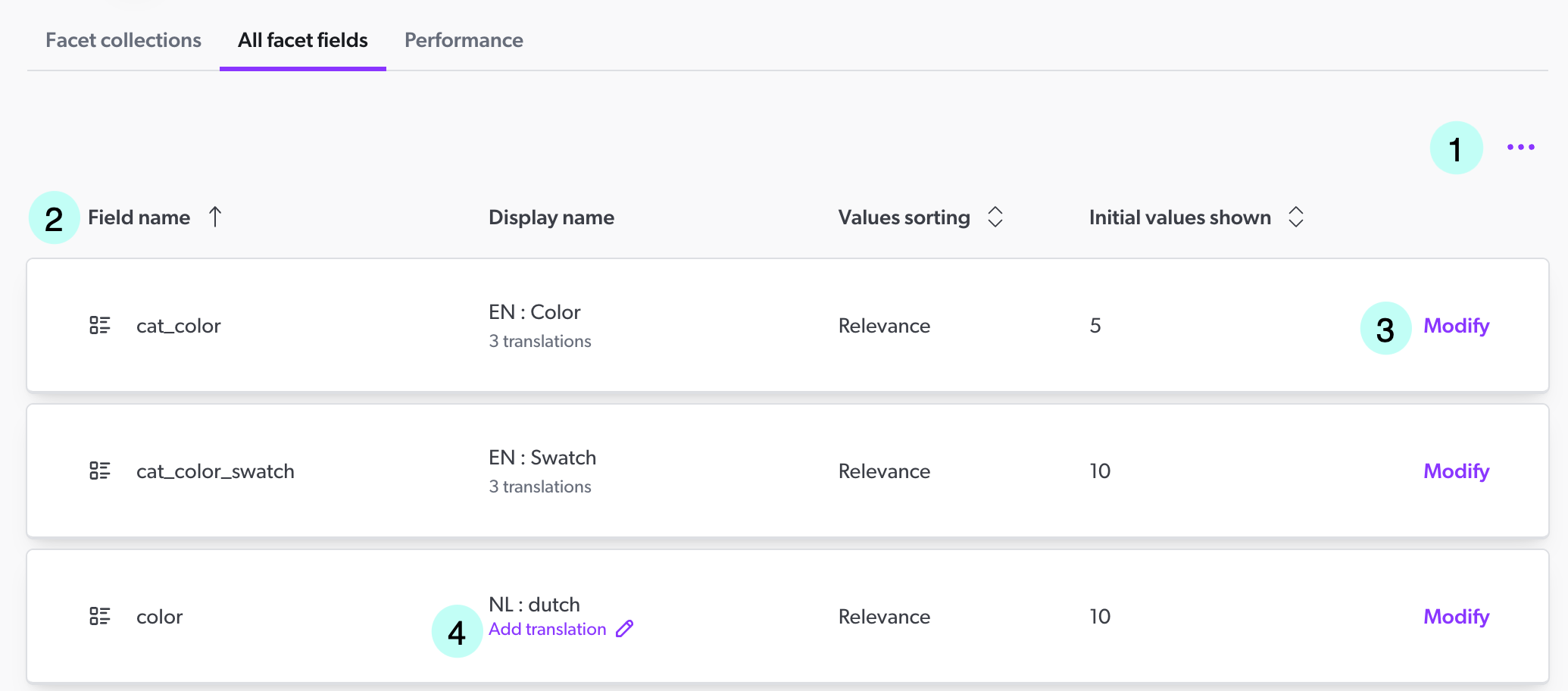
1 |
The |
2 |
The Facet field list displays all the facet fields available and their configurable settings. |
3 |
The Edit button lets the merchandiser edit the facet field's settings. When saved, these changes will be applied throughout the storefront. |
4 |
The Add translation button appears when at least one of the field’s display names is empty. This button lets merchandisers add a missing translation value to the facet field. |
Edit facet fields
|
|
When a facet field's settings are edited, the changes are applied throughout the selected property. |
Click Edit at the end of the facet field row to open the facet field configuration window.
Facet tab
The Facet tab lets merchandisers edit certain settings for the facet field.
-
Displayed name: Enter or edit a facet display name for each available language.
It’s important that all languages within a facet field are assigned a display name, especially when using relevance-based facets.
Example: The facet field
prod_cat_colorwould appear as such on the storefront if a display name wasn’t assigned. -
Facet type: If applicable, use the dropdown to select a facet type.
-
Selection options: If applicable, displays if the facet is configured as a single or multi-select facet.
-
Advanced options: If applicable, use the Include in filter suggestions button to select whether or not this facet should be eligible for filter suggestions. Note that the search interface must also be configured to display filter suggestions. See Implement filter suggestions and instant products for more information on configuring filter suggestions using Coveo Headless.
Values tab
-
For Regular facet types:
-
Use the Pin values edit button to pin facet values to this facet or edit the currently pinned values. Pinned values are always displayed at the top of the value list.
-
Under Values sorting, choose the type of value sorting that should be applied to the facet values.
-
Under Initial number of values shown, choose the number of values that are initially displayed to visitors when they land on the page. Visitors can then click Show more to see the rest of the values. The default is 10, and the maximum is 1000 facet values.
-
If applicable, under Multi-value selection, select the facet match criteria.
-
Select Match all values to require that all selected values be present in the results. For example, if a visitor selects "Red" and "Blue" under the "Color" facet, only products that are both red and blue will be shown in the results.
-
Select Match at least one value to require that at least one of the selected values be present in the results. For example, if a visitor selects "Red" and "Blue" under the "Color" facet, products that are either red or blue will be shown in the results.
-
-
-
For Hierarchical facet types:
-
Under Values sorting, choose the type of value sorting that should be applied to the facet values.
-
Alphanumeric will sort the facet values based on their name.
-
By number of products (high to low) will sort the facet values based on the number of products associated with each value, from highest to lowest.
-
By relevance will sort the facet values based on their relevance to the current query, which is determined by the Coveo platform based on index ranking and machine learning.
-
-
Under Initial number of values shown, choose the number of values that are initially displayed to visitors when they land on the page. Visitors can then click Show more to see the rest of the values. The default is 10 facet values, and the maximum is 32.
-
-
For Numerical-ranges facet types:
-
Under Facet value range types, choose how the range will be determined.
-
Automatic ranges require that you specify the number of ranges the values will be divided into. For example, if you have a price facet with values ranging from $0 to $100 and you choose to have 5 automatic ranges, the facet values will be divided into 5 ranges such as $0-$20, $21-$40, $41-$60, $61-$80, and $81-$100. The default number of ranges is 5, and the maximum is 10.
-
Manual ranges require that you specify the values that will define the range as well as the number of ranges. For example, if you have a price facet and you want to create 3 manual ranges, you could specify the following ranges: $0-$25, $26-$50, and $51-$100. The minimum number of ranges required is 2, and the maximum is 10.
-
-
Select Next: review to proceed to the next step and confirm that the changes will be applied throughout the property.
-
Select Apply once the changes are complete.
-
Performance tab
The Performance tab provides merchandisers with insights into facet performance on product listing pages (PLPs) and in search queries through the use of facet engagement.
The facet engagement percentage is calculated by dividing the number of times a facet's values were selected by the number of times the page or search query was viewed.
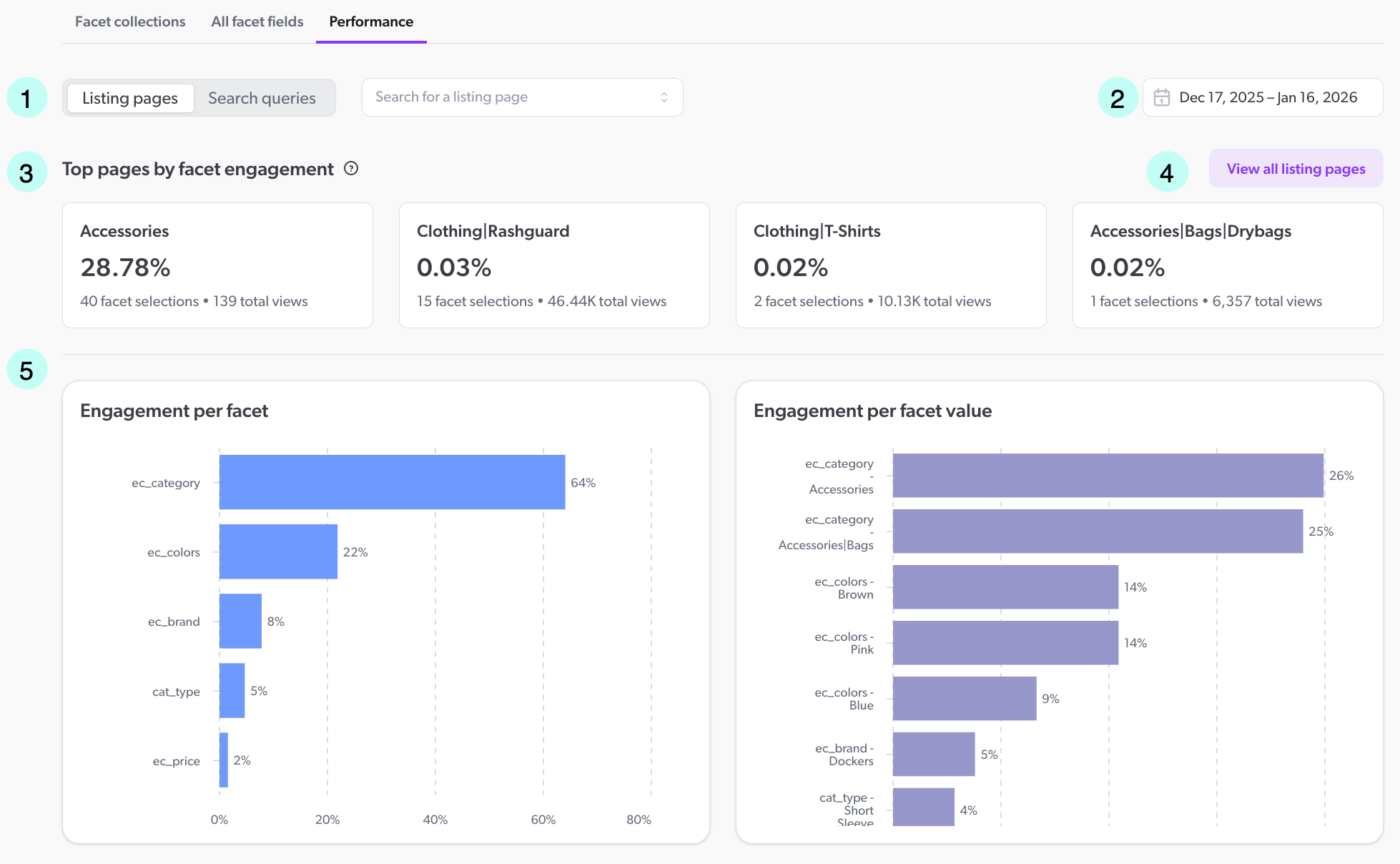
1 |
The solution toggle lets merchandisers switch between the Listing pages and Search queries views. |
2 |
The date picker lets merchandisers select the date range for the result display. |
3 |
This section displays the top facet engagement generators. |
4 |
The View all listing pages / search queries button lets merchandisers see a detailed table of all facets and their engagement. |
5 |
The Engagement charts provide a visual representation of the facet engagement. If there’s no facet engagement data available for the selection, the charts won’t be displayed. |
Engagement drill-down
Merchandisers can use this page to drill down through multiple layers of facet engagement.
Solution engagement
Use the solution toggle to display facet engagement results for either PLPs or search queries. By default, the page showcases the pages or queries that have the most facet engagement, and displays their metrics in the engagement charts.
Use the View all listing pages / search queries button to see a detailed table of all the facet engagement metrics.
Specific engagement
View the facet engagement for specific PLPs or search queries by using the dropdown list. Select one or multiple items from the list to see their combined engagement metrics.
The engagement charts will update automatically to reflect the facet engagement for the selection.
Facet engagement
Facet value engagement
View the engagement breakdown for a specific facet by selecting it from the Engagement per facet chart. Once selected, the Engagement per facet value chart displays the engagement for each facet value.
The more you know: All about facets
Facets are a powerful way to filter and refine search results based on specific attributes or characteristics of the products being searched. If you need a quick update on facets in general, consult the following section.

Facet types
The Facet manager allows merchandisers to configure different types of facets to refine search results and improve product discovery. Each facet type serves a distinct purpose, helping visitors filter products efficiently based on various attributes. The following facet types are available for configuration:
Regular (Selection list)
A standard facet that displays a list of selectable values, allowing visitors to refine their search based on predefined categories.
A clothing store with a Color facet listing options like Red, Blue, and Green.
Hierarchical
A structured facet that organizes categories into multiple levels, allowing visitors to drill down through a product hierarchy.
A furniture store with a Category facet structured as Living Room > Sofas > Sectionals.
Numerical - Slider
A facet that filters results within a numeric range, where values can take any number within the range. This is commonly displayed as a slider.
A price filter where visitors can set a range from $50 to $200.
Numerical - Ranges
The facet values are presented as pre-defined value ranges and invite the customer to choose the range that appeals to them.
-
Manual ranges are established manually by the merchandiser.
-
Automatic ranges are automatically generated based on the returned products.
A shoe store with a price facet could display ranges such as $120-$140, $140-$160, and $160-$180.
Facet value selection option
Multi-value facets allow consumers to select multiple values within the facet, unlike single-value facets which only let consumers select one value. Not all fields are eligible to be multi-value facets, however, only "string" fields can be configured as multi-value facets. For more information on facet construction, consult the Facet and multi-value facet article.
Facet ordering
The order in which facets and their values are displayed in the facet collection is an important aspect of the user experience on a storefront. The CMH provides a combination of manual and automatic ordering options to ensure that the most relevant and important facets are always visible to visitors.
Manually pinned facets
Manual pinning allows merchandisers to control the order of facets in the storefront, ensuring they remain fixed in that position. A merchandiser can pin up to 30 facets.
Use this feature to lock specific facets at the top of the list so they’re always visible to visitors.
For example, a clothing store may want to pin the Brand and Price facets at the top of the list to ensure visitors can always filter by these attributes.

|
Consider pinning facets that are used in most of your products (for example, |
Facets selected by relevance
Facets selected by relevance let Coveo dynamically choose which facets to display based on the visitor’s query or the listing page they’re browsing.
|
|
Note
Only "Regular" type facets that have the Facet generator option enabled on the Fields (platform-ca | platform-eu | platform-au) page are eligible to be selected by relevance. |
This feature leverages both the Facet Generator and the Dynamic Navigation Experience (DNE) model to optimize which facets appear, and in what order.
When a visitor performs a query or lands on a listing page, the Coveo Platform retrieves the most relevant products. At the same time, it determines which facets make the most sense to show for that context.
|
|
It’s important that all languages within a facet field are assigned a display name, especially when using relevance-based facets. Example: The facet field |
The Facet Generator looks at which product attributes stand out in the search results. It prioritizes attributes that are unusually common in the results compared to the overall product inventory. It also considers how often those attributes appear in the result set, with higher-ranked products being weighted more heavily. This ensures that the facets shown aren’t just popular—but also relevant to the visitor’s current context.
Finally, DNE re-ranks the selected facets based on actual visitor behavior, promoting the ones users interact with most often. This dynamic approach helps you maintain an adaptive experience—without having to constantly update your facet strategy by hand.
|
|
Generic attributes like |
The following diagram illustrates how Coveo evaluates and selects the most relevant facets to include in the facet collection:

A merchandiser managing an outdoor gear site wants to improve its facet selection.
To help visitors easily refine their searches, the merchandiser creates a facet collection in the CMH and manually pins the Brand, Size, and Price facets, ensuring that these always appear at the top of the facet list.
To further optimize the shopping experience, the merchandiser activates the Facets selected by relevance feature and sets the number of dynamically selected facets to 2.
These facets will be added alongside the manually pinned ones.
In total, 5 facets will appear on any page using this facet collection.
When a visitor searches for "backpacks", Coveo automatically determines which additional facets to display and the order in which they appear.
In this case, the most relevant facets are Waterproofing and Volume.
These are added to the manually pinned facets, resulting in the following facet list:
-
Brand -
Size -
Price -
Waterproofing -
Volume
Facet values sorting methods
Merchandisers can choose one of the following options to determine how facet values are sorted within the facet collection.
-
Alphanumeric: Sorts facet values in ascending order based on their alphabetical and numerical characters. This is typically used for values like brand names or product codes where natural sorting is expected.
-
By number of products (high to low): Displays facet values in descending order, from the highest to the lowest number of associated products. Useful for highlighting the most common or popular values first.
-
By relevance: Displays facet values in an order influenced by relevance to the current query, based on index ranking and machine learning. This ensures the most contextually important values appear at the top.