Configure Coveo for Salesforce
Configure Coveo for Salesforce

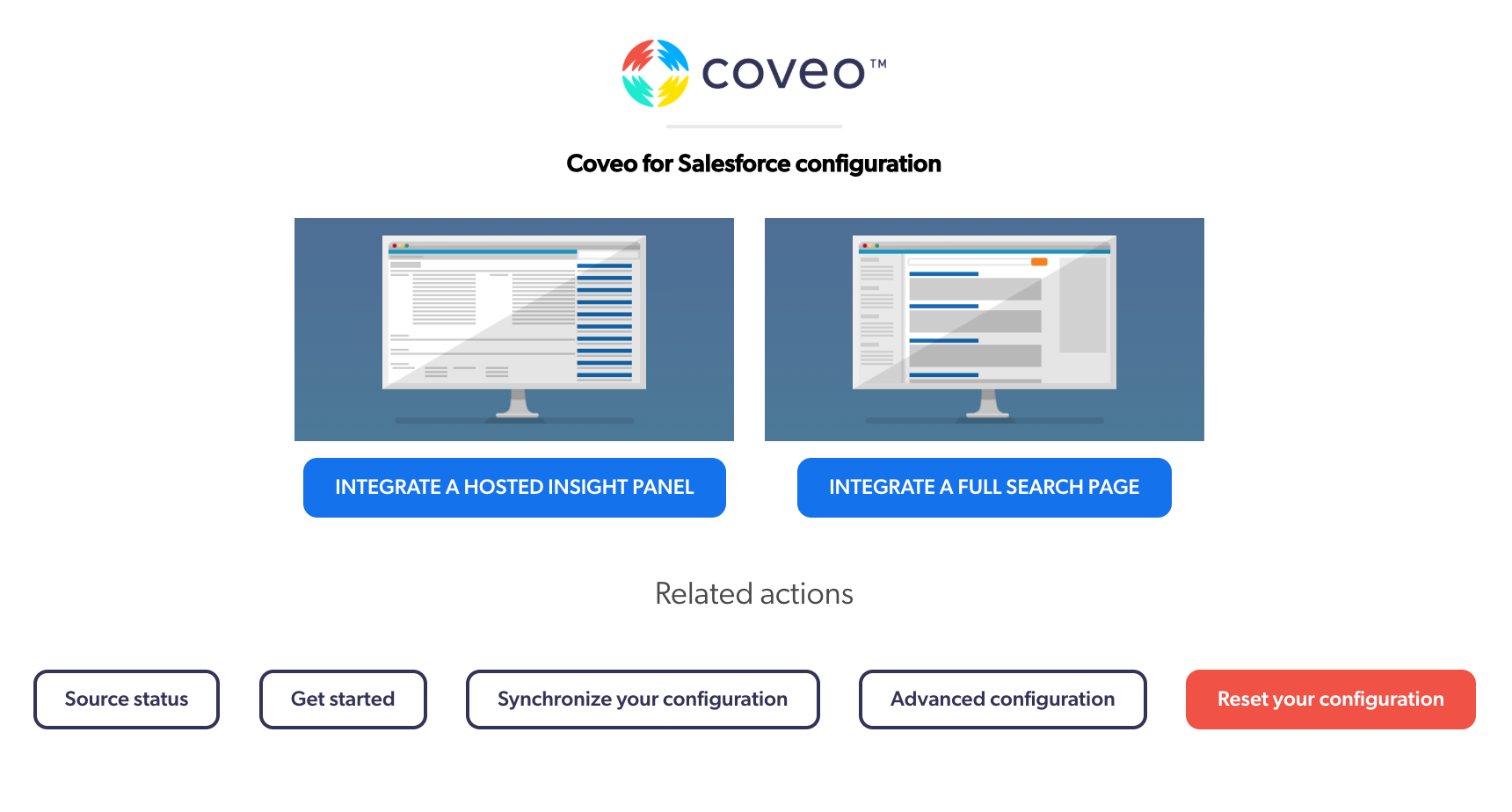
To manage your Coveo for Salesforce application, you can use the Coveo for Salesforce configuration page.
Accessing the configuration page
-
Make sure you have the right permissions to access the Coveo for Salesforce configuration pages.
-
From Setup, enter
installed packagesin the Quick Find box, and then select Installed Packages.Lightning experience Salesforce classic Under Platform Tools, select Apps > Installed Packages.
Under Build, select Installed Packages.
-
In the Installed Packages list, next to the Coveo package, click Configure.
Configuring your Coveo for Salesforce organization
The Coveo for Salesforce configuration page provides the following options:
-
Click Integrate a Hosted Insight Panel to learn how to Integrate the Coveo Hosted Insight Panel component.
-
Click Integrate a Full Search Page to learn how to Integrate a Coveo Full Search page in a Lightning Console app.
-
Under Related Actions:
-
Click Source status to check the indexing status of your sources without using the Coveo Administration Console.
-
Click Get started to access the Getting Started page that’s part of the Coveo for Salesforce package. This page provides useful resources to help you leverage your Coveo for Salesforce implementation.
-
Click Synchronize your configuration to ensure your Coveo for Salesforce application is synchronized with your Coveo organization.
-
Click Advanced configuration to manage the way your user profiles are handled during queries. See Using the Advanced Configuration page for details.
-
Click Reset your configuration to disconnect your Coveo organization from your Coveo for Salesforce application (for example, to switch from a staging organization to a production organization). Once you reset your configuration, you’ll need to provision your Coveo for Salesforce application again. For more information, see Reset your Coveo for Salesforce configuration.
-
Using the Advanced Configuration page


|
Modifying these settings can negatively impact your content privacy. |
-
To manage the profile used for your search queries before logging in, select one of the following options:
-
Anonymous Profile: Queries present content based only on the currently logged Salesforce user.
-
QueryingUserProfile: Queries present content available to the user performing the query and to the default querying user profile.
-
-
To manage the information sent to Coveo Analytics, select one of the following options:
-
Email address: The email address of the user is hashed before being sent to Coveo UA.
-
Email username: The first part of the email address is hashed, while the second part isn’t.
-
Nothing: The email address is left intact when sent to Coveo UA. This is the default and recommended option.
Hashing the email address may lead to your users essentially querying only publicly available content.
-
-
Coveo for Salesforce v5.2+
To use the organization endpoints for your search and analytics queries, enable the Organization endpoints setting. Organization endpoints improve separation of concerns, resiliency, and make multi-region and data residency deployments smoother.
This setting is disabled by default. Make sure the
<ORG_ID>.org.coveo.com(Search) and<ORG_ID>.analytics.org.coveo.com(Analytics) endpoints are registered as CSP Trusted Sites before enabling this option. -
To set a custom endpoint for your search queries, specify a custom domain name such as
mycompany.org.coveo.comfor the endpoint, and then click Test to validate the connectivity for your custom endpoint. Note
NoteThe Organization endpoints setting takes priority over the custom endpoint if both settings are enabled.