Product images for the Multi-Modal Catalog Encoder
Product images for the Multi-Modal Catalog Encoder

This is for:
System AdministratorProduct images are a first-class input to the Multi-Modal Catalog Encoder. This article describes how Coveo retrieves, validates, and manages the images that contribute to multi-modal embeddings, and how the encoder behaves when images are missing or unusable.
Image retrieval and storage
Product images aren’t ingested through your catalog source, and they aren’t stored as catalog items.
Your catalog indexes image URLs in fields such as ec_images, and Coveo retrieves the image assets from those URLs separately.
When a model builds, Coveo reads the image URLs from your already indexed catalog data, retrieves the images from your image hosting infrastructure, such as your CDN, and stores them in a dedicated image store within Coveo systems. Your catalog ingestion process is unchanged.
The following diagram shows how Coveo retrieves new or modified images from your image hosting infrastructure, caches them by URL, validates them, and combines valid images with textual content during embedding generation.
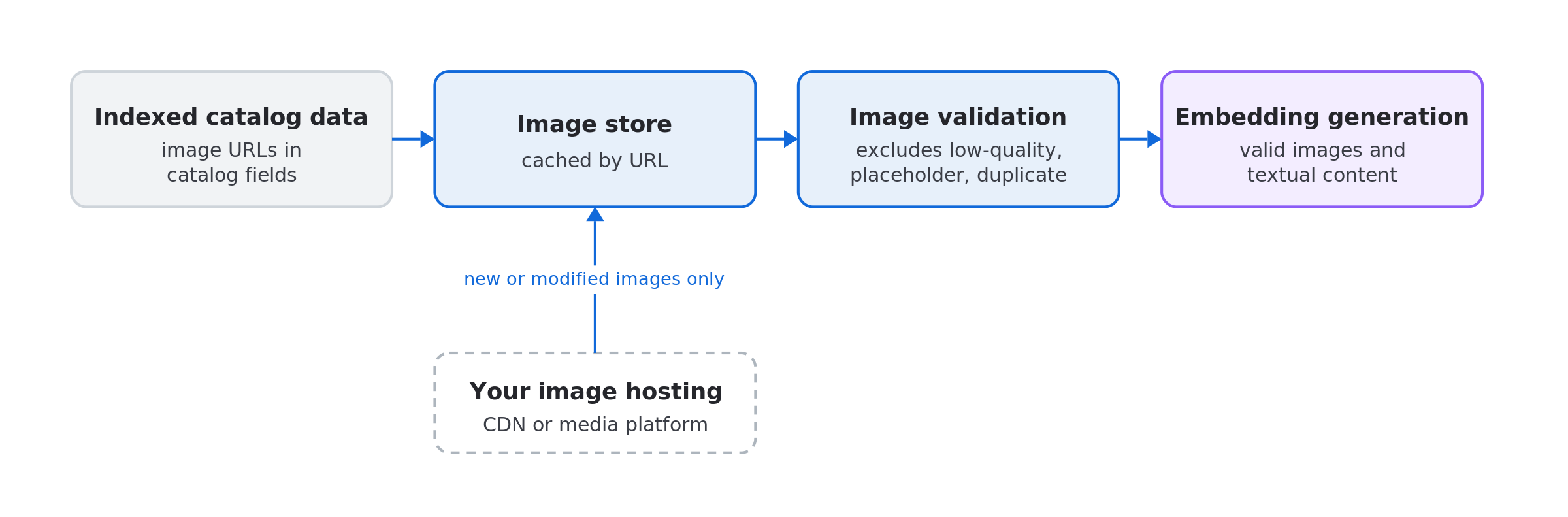
The image store uses the image URL as its cache key:
-
Images that were already retrieved during a previous build are reused from the store. They aren’t downloaded again.
-
Only new or modified images are fetched from your infrastructure, which keeps the load on your image hosting minimal.
-
For each image, Coveo tracks the last modified date. When an image changes, the affected product’s embedding is regenerated in the next incremental update.
Retrieved images are preprocessed into a standardized format before embedding generation.
Image validation
Not every image improves relevance. Before an image contributes to a product’s embedding, the encoder validates it and excludes images that would add noise:
-
Low-quality images: Images whose resolution or content quality is insufficient to extract reliable visual signals.
-
Placeholder images: Generic “image coming soon” or brand-logo placeholders that carry no product information.
-
Duplicate images: Identical images reused across many unrelated products, which would otherwise make those products appear visually similar.
Excluded images are ignored during embedding generation. The product’s embedding is generated from its remaining valid images and its textual content.
Missing or unusable images
The Multi-Modal Catalog Encoder is designed for real-world catalogs where image coverage is imperfect:
-
Catalogs with up to 50% of products missing images are supported.
-
Products without a usable image receive an embedding generated from textual signals alone.
-
Relevance degrades gracefully. A missing image never causes a product to be excluded from search results.