Complete permission model
Complete permission model

The simplified permission model generally lets you properly replicate access rights of the secured enterprise system you want to index. However, some complex secured enterprise systems may require you to define a hierarchy of permission levels, where the permissions derived from a higher permission level supersede those derived from subsequent lower permission levels. In such cases, you should use the complete permission model when adding or updating items.

|
You can’t define security identities in item permission models. The permission model of an item must rather refer to existing security identities retrieved through a security identity provider. For more information, see Security identity definition examples and User alias definition examples. By default, each object in the |
Effective permission evaluation
Once a security identity update has been performed and all security identities can be resolved to individual user entities, effective permissions are evaluated as follows for each item with a complete permission model:
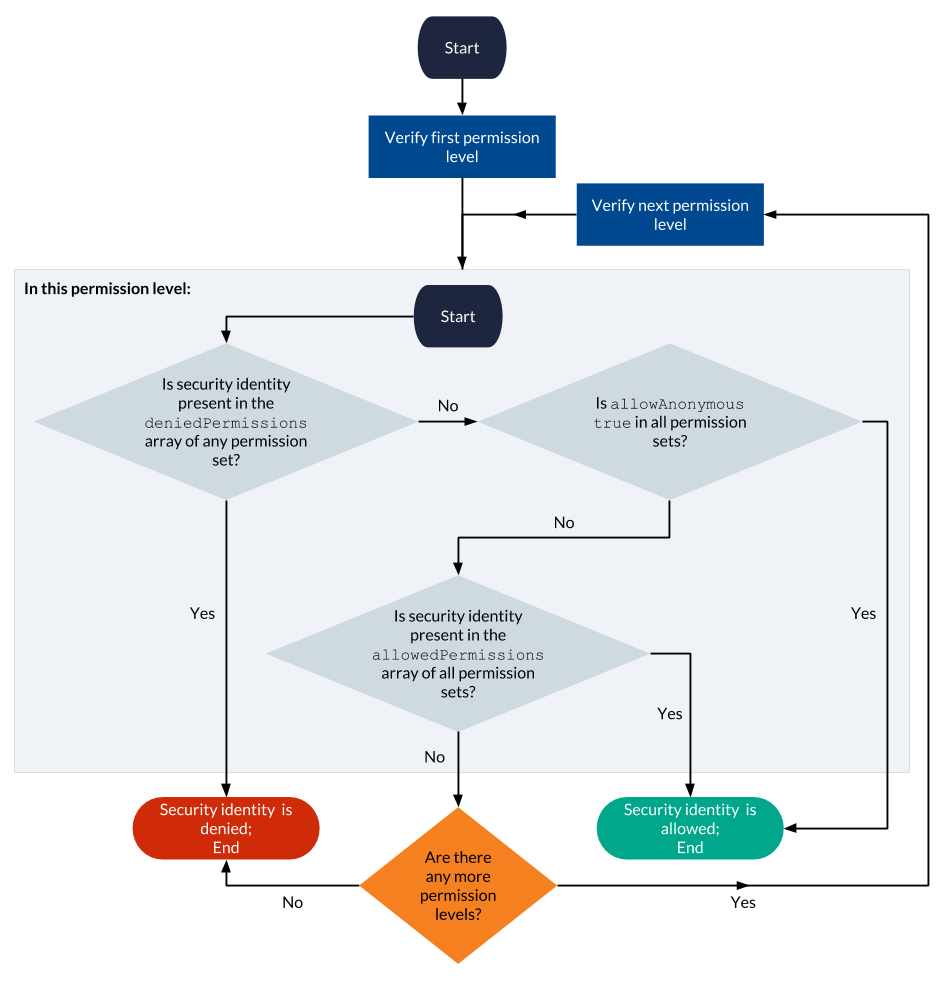
Defining many permission levels and sets
Suppose that:
-
The
SampleTeam1security identity group only contains usersasmith@example.comandbjones@example.comas members. -
The
SampleTeam2group only contains userscbrown@example.comanddmoore@example.comas members. -
The
MysteryUserXalias resolves to useremitchell@example.com.
{
  "permissions": [
    {
      "name": "Permission Level 1",
      "permissionSets": [
        {
          "allowAnonymous": true
        },
        {
          "allowAnonymous": false,
          "allowedPermissions": [
            {
              "identity": "SampleTeam1",
              "identityType": "Group"
            }
          ],
          "deniedPermissions": [
            {
              "identity": "SampleTeam2",
              "identityType": "Group"
            }
          ]
        },
        {
          "allowAnonymous": false,
          "allowedPermissions": [
            {
              "identity": "asmith@example.com",
              "identityType": "User"
            },
            {
              "identity": "cbrown@example.com",
              "identityType": "User"
            }
          ],
          "deniedPermissions": [
            {
              "identity": "bjones@example.com",
              "identityType": "User"
            }
          ]
        }
      ]
    },
    {
      "name": "Permission Level 2",
      "permissionSets": [
        {
          "allowAnonymous": false,
          "allowedPermissions": [
            {
              "identity": "bjones@example.com",
              "identityType": "User"
            },
            {
              "identity": "emitchell@example.com",
              "identityType": "User"
            }
          ],
          "deniedPermissions": [
            {
              "identity": "asmith@example.com",
              "identityType": "User"
            }
          ]
        },
        {
          "allowAnonymous": false,
          "allowedPermissions": [
            {
              "identity": "MysteryUserX",
              "identityType": "User"
            }
          ]
        }
      ]
    }
  ]
}
Case 1: User asmith@example.com performs a query
User asmith@example.com performs a query whose results would contain the item.
This user isn’t specifically denied in any of the Permission Level 1 permission sets, and is specifically allowed in all of those permission sets.
Therefore, even though Permission Level 2 would deny user asmith@example.com, Permission Level 1 takes precedence, and the user can see the item in query results.
Case 2: User bjones@example.com performs a query
User bjones@example.com performs a query whose results would contain the item.
This user is specifically denied in at least one of the Permission Level 1 permission sets.
Therefore, even though Permission Level 2 would allow user bjones@example.com, Permission Level 1 takes precedence, and the user can’t see the item in query results.
Case 3: Users cbrown@example.com and dmoore@example.com perform a query
Users cbrown@example.com and dmoore@example.com each perform a query whose results would contain the item.
Those users are both specifically denied in at least one of the Permission Level 1 permission sets.
Therefore, neither of those users can see the item in query results.
Case 4: User emitchell@example.com performs a query
User emitchell@example.com performs a query whose results would contain the item.
This user is unknown in Permission Level 1.
Consequently, Permission Level 2 is evaluated.
User emitchell@example.com isn’t denied in any of the Permission Level 2 permission sets, and is specifically allowed in all of those permission sets.
Therefore, the user can see the item in query results.
Case 5: An unauthenticated user performs a query
An unauthenticated user performs a query whose results would contain the item.
Unauthenticated users are denied in at least one of the Permission Level 1 permission sets.
Therefore, the user can’t see the item in query results.