Data collections
Data collections

Data collections are intended for administrators and developers who want to store and manage structured business data in Coveo. This article provides an overview of data collections, including their purpose, how they relate to other Coveo resources, and the types of data they can contain. It also introduces the key concepts and workflows involved in working with data collections.

|
Note
Data collections are actively evolving. Their capabilities and supported use cases may expand over time. |
What’s a data collection?
A data collection is a container used to store and manage structured business data provided by customers. Unlike sources, data collection items aren’t designed to be searched or used directly in search or recommendation features. Instead, they store datasets that provide context for Coveo features, such as Coveo Machine Learning (Coveo ML) models.
For example, suppose you have a Coveo commerce implementation that automatically logs events using Event Protocol. If you also collect in-store purchase data that provides additional insight into customer purchase patterns, you might want your Coveo Machine Learning (Coveo ML) models to use that information too. You can use an offline purchase data collection to submit this information in a format that aligns with the data collected online.
Because the features they support require consistent, high-quality data, Coveo predefines and enforces a data structure for each data collection type. Data collections offer flexibility in the data you can submit while providing a single mechanism for managing that data.
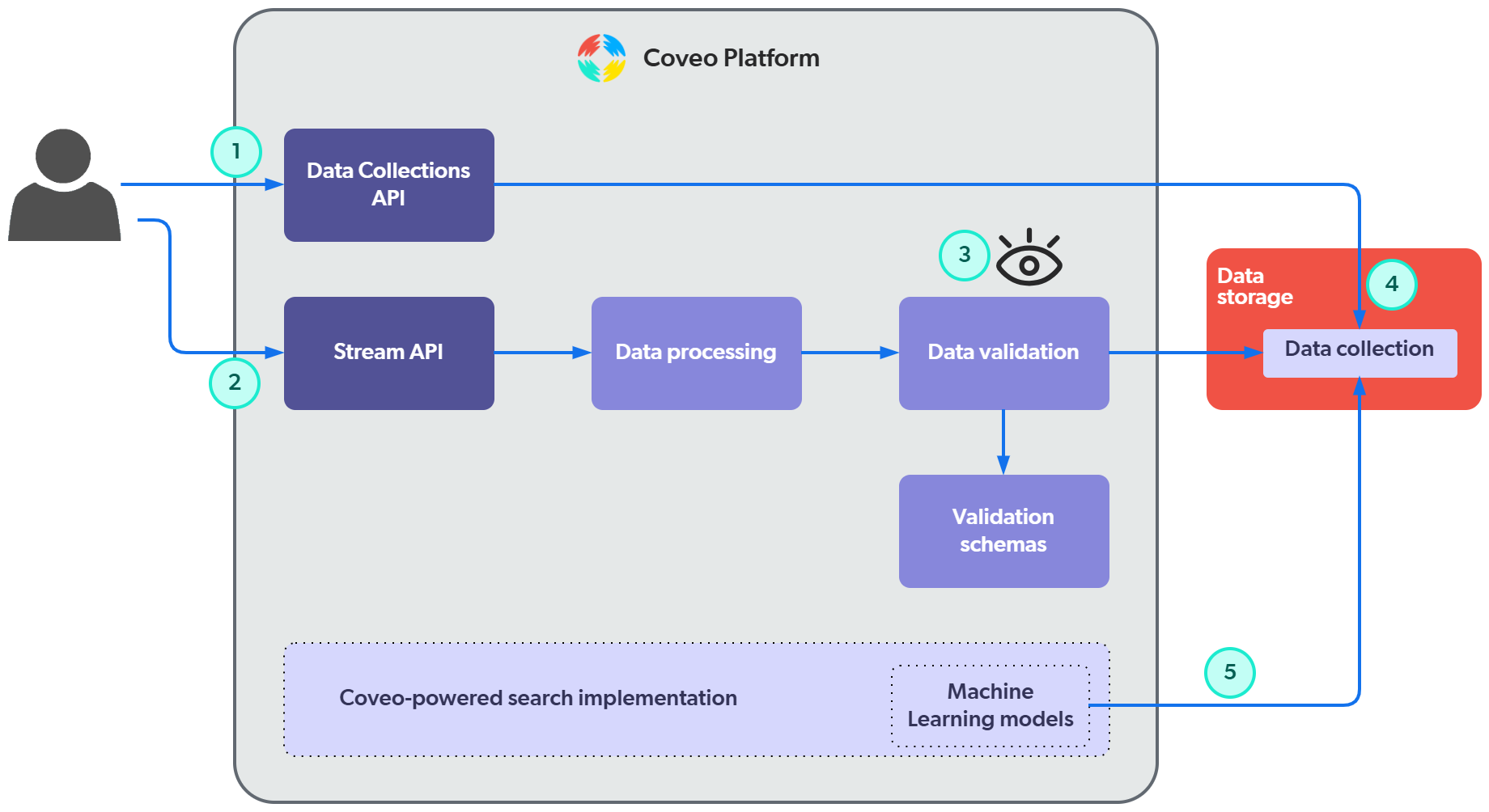
At this time, you must use the private Data Collections API to create a data collection. You can then use Stream API requests to add, update, and delete items in your data collection.
1 |
Before data ingestion, create a data collection using the private Data Collections API. |
2 |
Use Stream API requests to add, update, and delete items in your data collection. |
3 |
Added and updated items are validated against the predefined schema associated with the data collection’s Use the Log Browser (platform-ca | platform-eu | platform-au) to review validation errors and other issues with ingested data. |
4 |
Data collection items are stored for usage by internal services. |
5 |
(Coming soon) Coveo Machine Learning (Coveo ML) models will be able to use data collection items as training data, allowing you to provide additional context and signal to Coveo Machine Learning features. |
When to use data collections
As an initial use case, data collections can be used to send offline purchase data to the Coveo Platform for commerce customers. This will soon allow recommendation implementers to selectively train Coveo Machine Learning (Coveo ML) Product Recommendation (PR) models on offline purchase data and configure a recommendation strategy that more accurately reflects purchasing behavior across online and offline channels.
|
|
Note
Among further use cases, Coveo plans to use data collections to manage user profiles for personalized search and recommendations. |
 Very useful
 Not really
 Very useful
 Not really