Coveo Machine Learning Product Recommendation model update
Coveo Machine Learning Product Recommendation model update

The earlier version of Coveo Machine Learning (Coveo ML) Product Recommendation (PR) models will be deprecated in August 31, 2026. A new version of PR models is now available, offering improved relevance, better scalability, and a streamlined management experience.
All Coveo organizations using earlier-version PR models should migrate to the new version before the deprecation date. After this date, earlier-version models will no longer receive updates or improvements.
Timeline
| Date | Milestone |
|---|---|
Q1 2026 |
New PR model version available for self-serve creation in the Coveo Administration Console. Voluntary migration period begins. |
August 31, 2026 |
Earlier version PR models are officially deprecated and no longer supported. |
Scope
Your Coveo organization is affected if it uses the earlier version PR models.
To determine whether your models are of the earlier version
-
On the Models (platform-ca | platform-eu | platform-au) page, open the model you want to check.
-
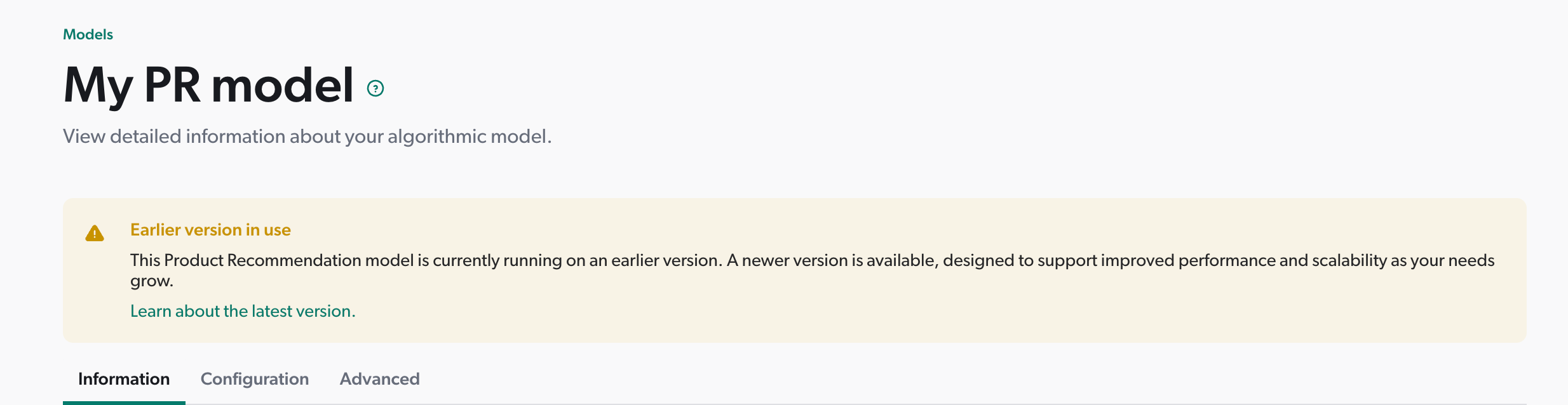
Models made with the earlier version are identified as such in a warning banner displayed at the top of the page.
What happens after the deprecation date?
Earlier version PR models won’t abruptly stop working on the deprecation date. However, after the deprecation date:
-
Earlier version models will no longer receive updates or improvements.
-
Coveo will no longer provide support for earlier version models.
-
Earlier version models will be decommissioned later, after which they will stop functioning entirely. To avoid disruption, complete the required migration steps before the deprecation date.
Benefits of upgrading
The new version of PR models brings meaningful improvements to your commerce experience:
-
Better and more diversified recommendations. Each strategy trains independently on the most relevant event data, improving recommendation quality and diversity.
-
Improved scalability and robustness. A standardized training limit of 100M events ensures fault-tolerant, predictable model builds, even for high-volume commerce implementations.
-
Fewer data dependencies. Category-based, localization-based, and user-based strategies require less configuration and fewer dependencies, reducing friction during the implementation process and maintenance.
-
Enhanced user-based strategy performance. User-based strategies no longer rely solely on user history. They also leverage purchase and view data resulting in more relevant and personalized recommendations for individual shoppers.
-
Streamlined management experience. A redesigned creation and management flow simplifies model setup and association directly in the Coveo Administration Console. All strategies are now available within the association flow, eliminating the need to edit an association’s JSON configuration.
-
Continued investment. Only the new model version will receive future improvements and new strategies. Migrating now ensures that your organization benefits from ongoing Coveo investment in product recommendations.
Your existing recommendation strategies, pipeline association process, and recommendation interfaces all remain the same. The migration is a model-level change. Your storefronts will continue to work without modifications.
Required actions
Coveo organizations using earlier version PR models must complete the following migration steps before August 31, 2026.
Earlier version models and new version models can coexist during the migration period, allowing you to validate the new models before decommissioning the earlier ones.
Step 1: Verify prerequisites
To use the new version of PR models, your Coveo organization must have a catalog entity configured in the Coveo Administration Console.
If your Coveo organization doesn’t currently have a catalog entity configured, contact your Coveo representative. A tailored migration path will be provided on a case-by-case basis.
Step 2: Create new PR models
Use the latest creation flow to create new PR models that will replace your earlier version models. The new flow provides a streamlined experience with explicit configuration options.
The new version supports the same product recommendation strategies as earlier version models. The new model leverages your existing analytics data, so you won’t lose historical learning when migrating.

|
The Buy again strategy isn’t yet available in the new version. It’s being redesigned for improved performance and relevance and will be available later. If you currently use this strategy, contact your Coveo representative to discuss your options. |
Step 3: Update your query pipeline associations
From the Models (platform-ca | platform-eu | platform-au) page, you can review the query pipelines that are currently associated with your PR models.
-
For each earlier version model, review its associated query pipelines and note their names.
-
On the Query Pipelines (platform-ca | platform-eu | platform-au) page, open the query pipeline associated with an earlier version model.
-
Update the associations to use the newly created PR models instead of the earlier version models. Make sure to replicate each association by selecting the same query pipeline condition and strategy.
Step 4: Validate and decommission earlier version models
Once you’ve updated the query pipeline associations to use the new version models:
-
Validate that the new model provides the expected recommendations in your storefronts.
-
After confirming that the new model performs as expected, delete the earlier version model from the Models (platform-ca | platform-eu | platform-au) page.

|
You can use A/B tests to progressively validate the new model’s performance against the earlier version model before fully decommissioning it. |
Get help
If you have questions about the migration or need help, contact your Coveo representative.
 Very useful
 Not really
 Very useful
 Not really